Monday, 22 November 2021

Our experience in the volunteering project "Para todos":

Laura Monroy & Juana Neyra (8th semester FIGRI students, The World in English elective)

“Para todos”, is a civil movement in which you can get involved to help people in need by delivering them some food. It's kind of like working as a delivery guy but with social work, which makes it so much better because you do it to help others! La Movida is a civil movement that started in the middle of the pandemic crisis. The owner of the movement, Cecilia, is aware of the amount of wasted food by restaurants, for this reason, she asks the restaurants if they can pack the rest of the food left and give it to us, so we can deliver it to people in street condition. The thing is, we don't have too many restaurants that help us in that social work, that's why she asks for chefs or people who know how to cook to volunteer in this beautiful work. 

We want to share our experience in volunteering in "La Movida: Para todos" because we consider that showing this is important. We want to encourage you and to invite you to do some social work, in which you will face the needs and the real situation of the communities. We want to show you a sneak peek of our journey in this volunteering, how we felt, and our reflections about this beautiful job. As a result, this blog will be divided into 5 parts. We will begin with the first outing of our volunteering in La Candelaria, second, we will describe the second outing in La Movida that was in the National Park in Bogotá, the third will be one of the most exciting that was the Big Movement called #UniversalPlate, the fourth is a short explanation of the Big Movement, and last but not least our conclusion about our experience in this volunteering. Let's begin! 

The main point of La Movida is to give nutritious lunches


First outing in La Movida: La Candelaria

Through these weeks of volunteer work providing food to those most in need, we have reflected on many things. During the first outing, we learned roughly how all of La Movida works. We went to a restaurant called "Quinoa & Amaranto" in La Candelaria, near Externado University. The main point of this volunteering is not only to deliver food to those in need but to know their stories, talk to them and have a big picture of the situation of people that lives in the streets. 

La Movida Team!

Quinoa & Amaranto packing the lunches!

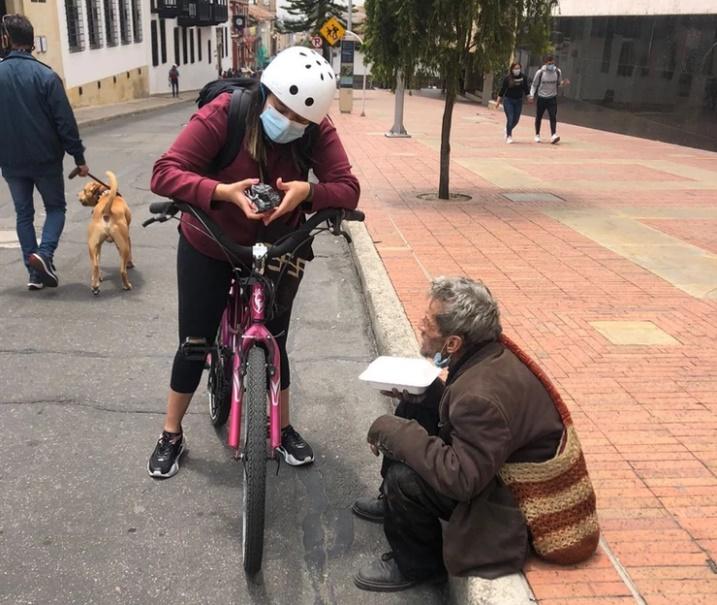
We took our bicycles and started to deliver the lunches around La Candelaria, which, is one of the places with more people in the street condition in the city of Bogota. We were able to see how many of the people, street dwellers, felt very grateful for the help provided, which shows how beautiful this work is. Thus, we could see that this was a fairly important situation because it shows the current situation in our country, and above all, of this community. Likewise, we felt helpless not to have enough lunches for everyone, we only had 20 lunches for a big community. Nevertheless, we were so satisfied with the volunteering work that we kept doing it the next weekends. 

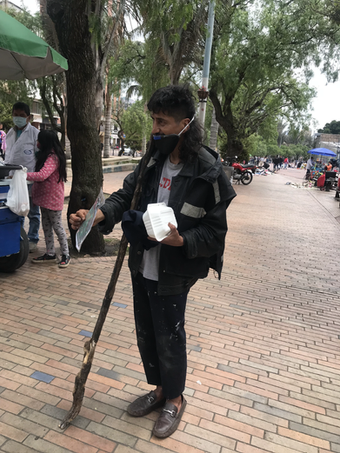
Here are some pictures of our first journey!


Showing me his artwork! 


Second Outing in La Movida: National Park 

During the second outing in La Movida, we went to the National Park, in which we have been told that there was an indigenous community out in the open, and they need food and clothes. Again, we went to Quinoa & Amaranto to pick up the food. We ride from La Candelaria to the National Park. 


Personally, I thought that we were going to help some indigenous community that was demonstrating against the national government. Nevertheless, we found a bigger issue, there was a big number of indigenous communities who are displaced by the armed conflict in Colombia from different departments like Cauca, Chocó, Arauca, etc. We had the opportunity to interview some of the leaders of the indigenous communities to have a big perspective of what is going on. His name is Alirio Velasquez, he came from Chocó to Bogotá in February of 2021, escaping the armed conflict. He told us that in Chocó the Paramilitary groups and the dissidents from the FARC guerrilla were fighting for the territory. As a result, he and his family had to run away and leave their crops, house, and life to escape violence. They arrive at Bogotá and the Mayor's office gave them every month a subsidy to pay the rent and to buy food. Nevertheless, in September the Mayor's Office stop giving them the subsidy. Thereby, they end up sleeping in the streets. We were shocked, because as a group, never thought that we would be facing some of the important internal issues of Colombia. 


Third Outing in La Movida: #UniversalPlate

During the third and last outing, was the Universal Plate. It was something very special and fun. Our group met in the Plaza de Bolivar for a massive day, where we delivered up to more than 8000 lunches for all those street dwellers. 


#UniversalPlateTeam

It was a very beautiful job; we had the assistance of many people willing to help. We were at the Bolivar Plaza. This place was chosen because in this area there is a lot of homeless and street workers who might like to have a free lunch for the day. We were so happy, to make them happy! but I'm not going to lie, it was hard work, really hard work. Every tent had a chef, that was the leader, and four assistants or helpers, we were helpers. We had to serve the soup, arrange the cutlery, and deliver the soups. It was an exciting experience, but very exhausting. In the middle of the day, we realize that the street workers couldn't move because they can't leave their business. As a result, we took a plastic box to put the soaps and started to give them to them. 


#UniversalPlate What is that and why is so important?

International Universal Plate is recognized for imposing the challenge for zero hunger in Colombia. On Saturday, October 16, during World Food Day, this gastronomic solidarity day was held where more than 8 thousand dishes of food were served to those most in need. This is a global campaign of Social Gastronomy, which integrates communities around the world through rich and nutritious dishes for free. The goal this year was to deliver 1 million dishes to the world.

Other similar projects internationally: Acción Contra el Hambre: 

Action Against Hunger is an NGO that supports local populations and refugees in their most basic needs and the most dangerous regions of the planet, providing nutrition, health care, hygiene, and food safety, teaching populations to be self-sufficient. Thus, food security projects address production, access, and income problems, help prevent and anticipate future outbreaks of malnutrition. For this reason, this NGO is in charge of developing projects designed to boost agricultural production and the activity of local markets, supporting micro-business initiatives to improve a vulnerable community's access to sustainable sources of food and income.


By telling you about other projects at an international level, we want to show you how this type of project can change a person's life. It is thus a universal project whose purpose is to be able to eradicate the ha, famine in certain areas of the planet. This type of project has advanced and prosperous, they allow to show the good results of this type of dynamics and thus, to be able to create new ones in other departments of the country and also encourage people to participate more in this type of events. 

In addition, there are many more projects of this type around the world. Not only by non-profit organizations but also by the States themselves, which decide to include this problem of hunger within their government programs due to its importance when it comes to guaranteeing fundamental rights. Likewise, these projects are located more in continents such as Africa and Asia, where poverty and social inequity prevail. The most affected are children, many times they do not reach their pre-adolescence and die of malnutrition. 


Spanish and American chef José Ramón Andrés Puerta temporarily converted his restaurants into community kitchens to provide lunches to support low-income families, the homeless, and the elderly. He created a nonprofit organization dedicated to providing meals in disaster areas and has also asked the government to do more to help the most vulnerable.
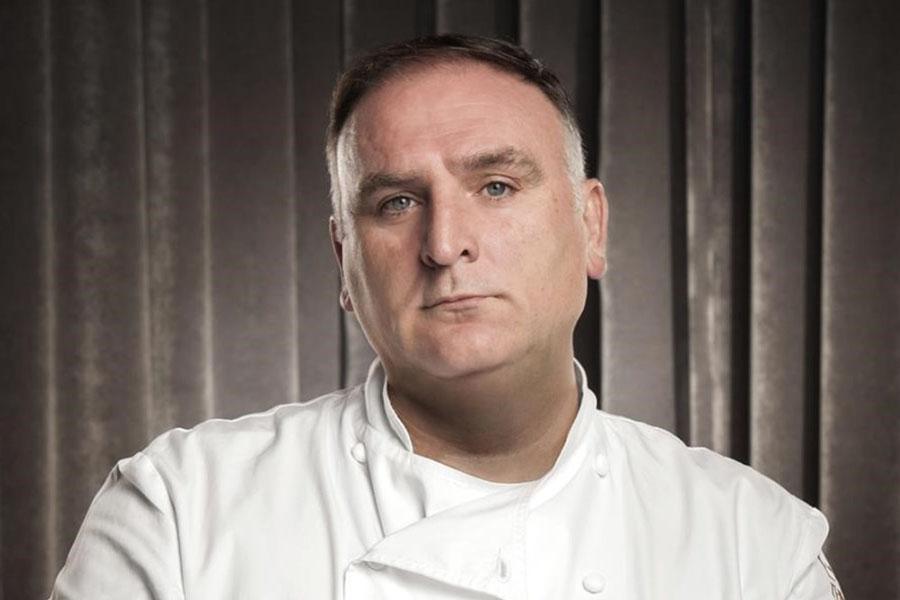

Chef José Andrés, humanidad sobre todo - Cocina y Vino


Conclusion: 

As you might notice, our experience was incredible! I'm very happy with all the work we have done and the love that we have spread. If you are those people that are helpful but don't know how to help or don't know any volunteering near you, I introduce you “La Movida: Para Todos”, a wonderful civil movement in which you can get involved with different communities by helping them to calm hunger among them. Our experience was incredible, we didn't expect to get involved in so many different communities, but also, we didn't expect to be with them and talk to them to find different solutions on how we can intervene to visualize the issue to the rest of the Colombian society, to spread the news to get more helpful people. We think that this movement is fighting an enemy that has been among us since the beginning of humanity, something that nowadays we ignore. We are very grateful for the knowledge that we acquire and the amazing time we spend with the members of La Movida and the people we helped. Our hearts are full of love and empathy towards the communities that we brought food and a little bit of joy.


Friday, 19 November 2021

The 'Para Todos' Project

 Do you know about 'Para Todos'? This wonderful video made by Social Communication students Mauricio Roa, Zaira Sofia Ariza and Danna Rocha for our The World in English elective tells us all about it!


Wednesday, 12 May 2021

Why do we need to think about how we live our lives?

Written by Zaira Sofía Ariza Varela, undergraduate student: "Lessons and reflections post Covid-19" elective


The question that has been posed to me is difficult enough not to have an immediate question, in fact, I will try to do what I never do: write on the fly rambling until I know the answer. Usually when I’m asked a question or a social problem I know what to answer, I’m an intelligent person, or at least I think so. Most of the time I constantly review news, documentaries, poems and books, even if that means risking my academic life; surprisingly, this has helped me to enter classes totally lost and yet have the capacity of abstraction not to fail any subject.


When I entered college it was as if a cargo truck pushed me into a mesh full of spikes. I didn’t know anything about what I was doing with my life, I didn’t know what I wanted or what I was doing there, and to be honest my career was my last option (and what a good last option it was). I remember the first blow as if it had been a fist in the face, of those subjects that are never forgotten and that cost, the terrifying subject called Logic, where Heidegger hit me with his Nazi intelligence.

To my surprise I never needed tutorials, or at least, not to pass with a relatively decent average, and I always knew how to divide my time to do college things moderately well. That semester I failed one of the three midterms of Logic, and I remember very well how it was because that day I met Sebastian, or well, I already knew about his existence because he was a monitor of said class, but it was the first time I interacted with him. The events were more or less like this:

I felt very confident when I arrived to my midterm because according to me, I had enough knowledge to defend my position but as soon as I entered the classroom I realized that this wasn't the case. There were always three of us in each midterm: the first girl took over everything, leaving me, one of the calmest girls and little concerned about the exam, totally exposed to being massacred by the two people responsible for my grade, Sebastián the monitor and Samuel the teacher. My sentence was written.


Now I know that Sebastián has dedicated his whole life to the history of dissident subcultures and social struggles, but back then I did not know this and it was like going into the mouth of the wolf: a great mistake. That day I just wanted to get out of there: I wasn’t sad or angry, but I was rather embarrassed. My tactic of never formally studying had failed... But I did learn something that day and I would discover more about this in later semesters. That day I was curious to question myself, to ask myself how I live, how I manage my life and how cultural reactions to inequity permeate our society.

That semester I passed all the subjects even if I didn’t know very well how: I’ve always been a fish out of water. The next semester didn’t change much. I kept living my life, kicking in the ocean of the unknown, trying not to give up much of my academic life while doing what I wanted. This changed only in the third semester.

After overcoming my irrational hatred towards Sebastián for having made me fail a midterm that I deserved to fail I decided to follow him online. He is a handsome guy and besides we had various friends in common in the faculty. It was at that time he received his second death threat. The first was in November 2019 during the National Strikes, around when I marched for the first time.


He had always been a person far removed from urban disorder. I had studied at a remote school in northern Bogota where traffic and working life were never affected by the 'vandals' who disrupted social order: I was always outside, in a paper bubble. Quite the opposite of studying at the Externado.

I don’t remember very well how I ended up marching those days. I think it was because I met people in the Externadist Movement, the group of students who organize things to show their discontent in the streets without putting our life in danger. I, again, did not know very well what I was doing, I only knew that the police were breaking human rights regulations in the demonstrations and that the country was shedding the blood of ex-combatants. That was enough for me to go out and demonstrate.

When I really questioned myself explicitly was during the public denunciation of the death threat received by my ex-monitor: it was as if a shock had abruptly hit me on the head to finally realize the reality. How could a 20-year-old be threatened for being a student leader? How could Dilan Cruz have been murdered in cold blood that same year? How was it possible for the police to persecute students who decided to show their indignation to an incompetent government? There I understood it, I lived in an idyllic utopia, one in which there were no questions but only mechanical movements, the same ones that made my life in automatic mode.

When you start to have that social awareness everything changes: it’s like in the movie They Live, like putting on glasses to discover reality. This is the search for social justice, and this is how I decided to question life itself.


Friday the 13th of March was the last day I set foot in college in the third semester. I remember that day very well and also the day I stepped on those huge block stairs again, which was about eight months later when I went to my friend Ricardo’s house. That trip downtown after so long hit me with almost the same intensity that it had in the first semester of college: like a cargo truck against a barbed mesh.

The routine of university classes did not let me think much. Between the ups and downs of assignments, copies, friends and training I did not know how lucky I was to have a normal life, an average college life. That changed when I went back to 11th Street. There were many empty businesses, the same ones where I had obtained my semester readings, the backstreet bar was no longer there, the streets were deserted and the restaurants closed. Again, my questions appeared like iron burning on my skin: the pandemic had highlighted the inequality of the neoliberal system.

My family and I survived the crisis because we are part of our basic necessities, food. For me from the beginning it was terrifying to go outside (thanks to my special permission I was able to go outside from the beginning of the pandemic) and seeing the empty streets I always wondered about the informal vendors and what would become of their lives. If we did not think about them before, in times of crisis, their inattention was incomparable. At the same time, the killing, harassment and persecution of human rights leaders, farmers and indigenous people did not stop. Sebastián received his third death threat at the height of the pandemic.


____________________________________________________


After describing my experience about how I questioned my feelings I still do not know how to solve the question posed, but maybe it is worth wondering how we are living because this is just the minimum we can do to change ourselves and change the world. This sounds ridiculous, I know, but it’s what must be.


The human being is always asking himself questions, such as the origin of his existence, the creation of life, the creation of the world, everything. This is how it's always been, and being restless and with a need to find his way in the world is just natural. It’s the same with what surrounds us.

We’re used to being in our comfort zone most of the time but life always takes care of pushing us into our own sarcastic mesh to get out of there and grow and evolve. So it is with our way of life. The pandemic has only made us refine that ignorant need to want out of inexperience. Covid-19 was nothing more than our cargo truck, it was that impulse that made us see through the "Se Arrienda" signs the need to see ourselves in the mirror and ask: 'Why do I have to worry about how I live?’ For out of that question hangs our life, our future. However, ask this to the street seller who ran out of money, or the farmer who is seven meters underground with a bullet in the head. Or better yet, remember that you probably had, or have, a person infected with the virus.

If we do not ask ourselves about our present, our future will be diluted.

Tuesday, 11 May 2021

How has humanity lived and/or destroyed itself up until recently?

Written by Sofía Franco, undergraduate student: "Lessons and reflections post Covid-19" elective


While thinking about how to approach this topic I had a mild panic attack, not only because of how intimidatingly broad this question is, but because it made me come to a worrying realization: today, in the fourth week of the semester, I haven't learned anything from most of my classes.  I do log into -most of- the sessions, but I would be lying if I said I’ve made efforts to keep up. I'm not saying that I don´t care about university.  If I didn’t, I wouldn’t be panicking right now, but how else can I describe what is happening? Objectively, online classes require a lot of self-discipline, which is why -at first glance- we can only blame ourselves for the lack of investment. As the assignments pile up and the tests get nearer, I can’t help but feel guilty, irresponsible, mediocre and a bit useless. I know I’m being hard on myself, but it is hard -if not impossible- to compare ourselves to others. I see some of my classmates keeping up, taking good notes, participating… learning… and I can’t help but wonder if I am the problem.


Of course, nobody forced me to take this online semester.  I chose to do so even if I was aware of the conditions.  I knew what I was getting myself into. The other two online semesters haven’t been easy …But then, why did I choose this if it's so mentally exhausting for me? While thinking about it I concluded that that is what I want to talk about in this reflection.

Last year I read an interesting book “the burnout society” by Byung Chul Han. In this book, he states that we are so overly positive -or pretend to be-, that we end up being exhausted, frustrated and depressed. We always want to overachieve, and while at it we proudly exploit ourselves and call it hard work.  We praise those who do the same and believe we can always do more. We shame leisure time; we only value the time we invest doing something that brings some type of tangible profit and we’ve made life seem like a race against time. We all want to be “successful”, and we often associate that word with fortune and prestige. This is of course a direct consequence of capitalism and liberalism and I personally believe it is a way in which we are destroying ourselves. 

We are wired to follow a certain path, a path that we hope will lead us to financial stability on our own merits, but what are those merits? And is it actually attainable? Isn’t it an illusion sold by the privileged elite in order to keep benefiting from the will of the working class to exploit itself in exchange of crumbs from their fortune? Liberalism -and particularly neoliberalism- has us believing that being able to sell every single minute of our time is freedom - even selling our bodies is freedom. 


It has us believing that if we “work hard” we can achieve anything, even the lifestyle that billionaires have. For instance, Elon Musk, the richest man on earth, is an icon to a huge group of people as they believe he earned what he has by “working hard” when in reality, he hardly worked:  he cheated and bought his way to the top, and now people believe it’s through merit. If him or Jeff Bezos wanted to, they could end world hunger and STILL be rich! People can work their whole lives and still never be able to even afford housing and a decent living standard.

Money -or the illusion of it- ends up being the reason for everything: on many occasions we chose what we want to study thinking about how we can profit from it later.  Then we go to college -and pay for it- to get a degree that will make us more competitive on the labor market.  We try to stand out because good grades mean a good CV, and a good CV means more job opportunities, and a job means more money… Besides, not only do we build our whole lives around money, but we also try to do it as fast as we can! 

A 22-year-old, such as myself, is considered “old” for being in 5th semester of a bachelor’s degree. Most people I graduated high school with are already halfway through their Masters and that is normal! I can´t help but feel like I’m late. I know there's no such thing as “late”, and I know it is ridiculous for me to be thinking about it, but, as I said, I literally cannot help it. Why do I feel this way? Because from an early age we are programmed to believe this definition of success:  the quicker we start making money, the better, and as the world becomes more competitive by the minute;  a “safe” way to assure a good place on the hierarchy is to get a ton of degrees. 


However, that is not enough.   People also seem to have an expiration date: younger people are more appealing -younger people with tons of degrees and experience, of course.  That is a huge contradiction, but it is true. This unattainable expectative is unhealthy and hard to ignore.  For me, being aware of it does not really change it. I am in a rush to get my degree and move on to the next thing.  I can’t conceive  postponing  a semester because that would mean I would be even later. To what? I don´t exactly know; I just know that I would feel guilty and mediocre. I am very tired of thinking like this. I’m making an effort to stop, but while I’m at it I can definitely conclude that humanity is destroying itself with this mentality.  This mass production/consumption scheme has us believing that self-exploitation is something to be proud of and that we have to do everything as fast as we can to get… where?

It might seem I’m obsessed with the topic of money and that  I shifted a bit from my initial reflection, but I don't think I did. I believe my lack of motivation is deeply linked to what I mentioned. It can all be summed up in two words: mental health. Not everyone is affected to the same extent by the same factors, but I can only speak for myself. I am worried sick about money; I am worried about being worthless because I am not achieving anything tangible at the moment; I am worried I never will because, in this context, I’ve proved  myself incapable of doing things that I don't find enjoyable and, even more so, I’ve proved  myself incapable of overcoming my mental blockage. If I can’t even force myself to keep up with 7 subjects, how can I expect to succeed in such a competitive self-exploiting world? And if I can’t, why do I even bother trying?


Thursday, 29 April 2021

The comfortable but unbearable polarization era

 By Paula Andrea Álvarez Castillo (second semester FIGRI student, level 6 English)


Social - political polarization supported by social media is taking place in our daily lives. In fact, social media have been collecting our data and reactions about different topics according to an algorithm  that classifies information and people according to their beliefs. In this way, each person could see on their "feed" a certain type of predetermined content. People are more exposed and influenced by certain types of information, a factor that undoubtedly creates a terrible radicalization in perspectives: polarization.

In this way, Colombia is no exception. As a population, sometimes we have not realized the relevance of our social media content and the powerful message it has for our mind or political position. For instance, have you thought about how your ideology has been influenced by social media content? Or have you been thinking about why in your feed, this is usually news related to your viewpoint about different topics? It is possible that you haven't. And it is not your fault.


First, it is important to mention that the factor of Colombian historical violence has been building a path of undoubted social and political polarization. In fact, usually it is possible to view the same perspectives about political issues in social media such as Facebook, Instagram, Twitter, etc.: likes, shared posts, views or the receptors of "emotions" and reactions are providing information to the algorithms that then make up the feed about your possible beliefs. In this sense, they are disconnecting people from other possible perspectives.

Consequently, this factor makes you become more involved and focused on the topic and perspective being discussed, with the consideration that it could even be fake. This is discussed in the documentary "The Social Dilemma" when an ex-manager of social media says: "one of these biggest problems there, is that it could be the best persuasive tool ever created”.

In this way, this is big problem of the influence in beliefs and perspectives. Now, people looking at posts think that they have enough information to construct their opinion in the "post-truth age". However, what they do not know is that behind their online activity, there is a mechanism that wants them to be in front of the screen all day. Furthermore, the person and society are the subjects that are going to be really affected by all of this.


To illustrate this fact, a clear example of how this “manipulation” works to create social polarization is  the TikTok app. When the person registers there, they start to view content according to their interests, a factor that makes people feel comfortable with this "social acceptance place". Then, when they see something or someone different, they reaffirm their values, reaffirm their “understandable perspective”, classify the difference as wrong and create this terrible polarization.

To sum up, the social and political polarization supported by social media is a terrible phenomenon in our daily lives. The algorithms have been disconnecting us from each other and creating problems in society in favor of private interests. Consequently, it is necessary that we are in touch with different types of content, with different perspectives and realities. We need to go out of our comfort zone and understand “strange beliefs”. It might not give us comfort, but this is necessary to leave this “comfortable but unbearable polarization era”.

Thursday, 12 November 2020